Open to scientist roles in cancer genomics & gene regulation — academia or industry
Mallikarjuna Thippana, PhD
Computational Biologist — Cancer Gene Regulation, 3D Genomics & Computational Methods
Postdoctoral researcher at Karolinska Institutet studying how distal regulatory elements switch oncogenes such as MYC between low and high expression — using nascent-transcription, chromatin, single-nucleus and whole-genome data in reproducible Python/R workflows. Author of two published, open-source gene-prioritisation algorithms.
Nov 2026New workflow: endometrium snRNA-seq pseudobulk with TF/pathway activity and donor-robustness checksNov 2026Released five new CI-tested workflows on public ENCODE, TCGA and single-cell dataNov 2026LAN-5 neuroblastoma WGS: MYCN amplicon reconstructed and classified ecDNA-positiveJul 2026Released CI-tested, Zenodo-archived code for both published gene-prioritisation methodsJan 2026CTCF/MYC preprint on bioRxiv (co-author) — now under revision at Nucleic Acids Research2026Lung squamous cell carcinoma paper in print, J Biomol Struct Dyn 44(3)
I'm a computational biologist with a PhD in Computational Systems Biology, working on cancer regulatory genomics, 3D genome regulation and integrative multi-omics.
In Dr Anita Göndör's group at Karolinska Institutet, I study how a distal CTCF-binding site and long-range enhancer contacts shape MYC expression — combining nascent transcription (GRO-seq), chromatin accessibility (ATAC-seq), protein occupancy (CUT&RUN), chromatin contacts (4C-seq) and RNA-seq to prioritise hypotheses that the wet lab then tests. In our recent preprint, a single CTCF site in the CCAT1 super-enhancer turns out to act as a switch that pushes cells towards low or high MYC. I also lead the analysis of a clinical snRNA-seq cohort and analyse cancer whole-genome data for focal amplifications and ecDNA.
During my PhD, I designed and published two original gene-prioritisation algorithms (chaos-game/multifractal and moment-of-inertia tensor), now available as tested, open-source Python packages. I care about reproducible analysis — Git, Nextflow/Snakemake, containers and Linux HPC — and about explaining results clearly to experimental colleagues and students.
8Peer-reviewed journal articles
3Preprints / manuscripts, incl. one under revision at NAR
2Original published methods with open-source code
5MSc dissertations supervised
What's next
I want to understand how cancer cells use their genomes flexibly — through changes in gene regulation, genome structure, and cell state — to grow, adapt, and resist therapy. My aim is to combine large-scale genomic, epigenomic, and single-cell data with rigorous computational methods to turn these mechanisms into testable hypotheses, biomarkers, and therapeutic opportunities.
Along the way, I want to keep building robust, reproducible analysis — from method development to clinical cohorts — in teams where data analysis helps decide what to test, target, or develop next.
Research Focus
What I work on
Four connected areas: how cancer genes are regulated, how cancer genomes are rearranged, how cell types differ between patients, and the methods that tie it together.
Gene Regulation & 3D Genomics
How distal CTCF sites and enhancers control MYC, and how that control creates cell-to-cell variability in oncogene expression.
Cancer Genomes & ecDNA
Reconstructing focal amplifications — ecDNA, breakage-fusion-bridge and complex amplicons — from WGS with AmpliconSuite and nf-core/circdna, starting with public data from the MYCN-amplified LAN-5 neuroblastoma line.
Single-Cell Transcriptomics
Multi-donor sc/snRNA-seq with Scanpy and Seurat: QC, ambient-RNA and doublet removal, Harmony integration, annotation, and cell-type-specific differential testing.
Computational Methods
Original alignment-free gene-prioritisation algorithms, network biology and WGCNA, and statistical modelling of high-dimensional cancer-cohort data (TCGA/GEO).
Experience
Research Experience
From cancer network biology and method development to regulatory genomics in a clinical cancer research department.
Department of Oncology-Pathology, Karolinska Institutet, Solna, Sweden
Group of Dr Anita Göndör
5,175
differential ATAC-seq regions
1,816
nascent-transcription DEGs (GRO-seq)
98
shared multi-omic candidate genes
17
donors in clinical snRNA-seq cohort
MYC/CTCF enhancer control & 3D genome regulation
Combine GRO-seq, RNA-seq, ATAC-seq, 4C-seq and experimental evidence to study enhancer activity and long-range regulation of MYC — co-author of a study under revision at Nucleic Acids Research showing that a CTCF site in the CCAT1 super-enhancer coordinates a negative feed-forward loop that diversifies cells towards low or high MYC
Analyse NUP133 CUT&RUN occupancy relative to CTCF sites and enhancer annotations; TF-motif and CTCF-regulatory enrichment to prioritise hypotheses for experimental testing
Chromatin priming under p60AmotL2 / iBET151 perturbation
Integrated ATAC-seq, RNA-seq (305 DEGs) and GRO-seq to narrow thousands of changes down to 98 shared candidates, 38 of them chromatin-priming candidates for follow-up
Clinical snRNA-seq — human endometrium in PCOS
Lead the computational analysis of the cohort (5 controls, 12 PCOS): QC, Harmony integration, epithelial/stromal/immune/endothelial annotation
Cell-type-specific differential expression and variability analysis, plus CTCF-binding enrichment near affected genes
Cancer WGS — focal amplifications & ecDNA
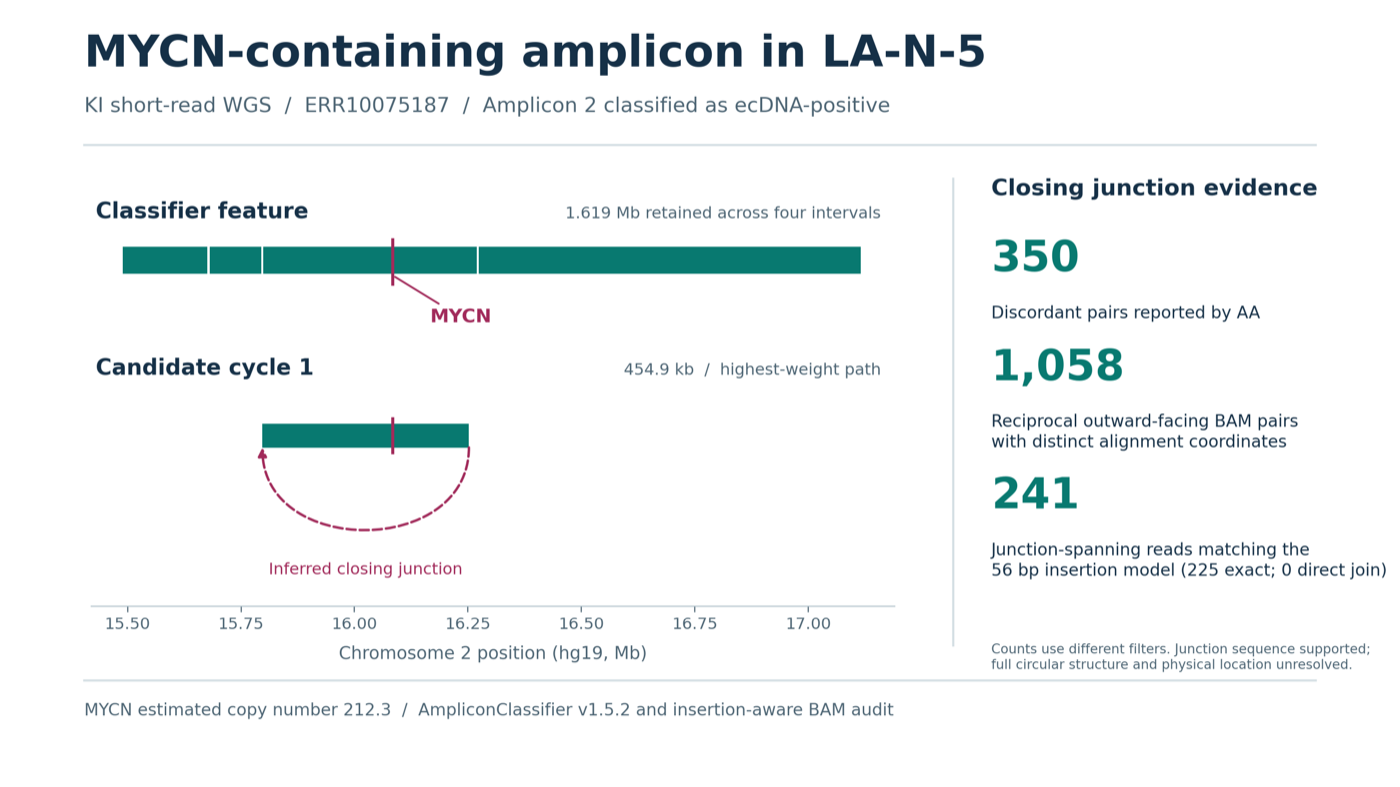
Built and validated the ecDNA workflow on public whole-genome sequencing of the MYCN-amplified LAN-5 neuroblastoma cell line: AmpliconSuite (PrepareAA, AmpliconArchitect, AmpliconClassifier) and nf-core/circdna on Linux HPC to reconstruct and classify its focal amplicons — the MYCN amplicon (copy number ≈ 212) is classified ecDNA-positive, with the closing junction of a 455 kb candidate cycle supported by 241 reads
The same reproducible pipeline is next being applied to the group's tumour whole-genome data
Transcriptomics of HIV–cancer pathway crosstalk
RNA-seq of an HIV-positive patient cohort to identify patient-specific expression signatures and crosstalk with oncogenic pathways
IoE Postdoctoral Fellow — Computational Drug DiscoveryJul – Nov 2024
University of Hyderabad, India
Python-supported docking, pharmacophore and ADMET analyses to rank candidate anti-cancer tyrosine-kinase inhibitors for follow-up
PhD Researcher — Cancer Systems Biology & Computational Methods2018 – 2024
Dept. of Biotechnology & Bioinformatics, University of Hyderabad — ICMR-funded
Analysed TCGA/GEO cancer cohorts with transcriptomic, genomic-variation, network, pathway and survival evidence to identify molecular regulators of cervical squamous cell carcinoma
Conceived, implemented and published two original gene-prioritisation algorithms — chaos-game/fractal analysis (Theory in Biosciences, 2024) and moment-of-inertia tensor analysis (Proteins, 2022)
Applied WGCNA, protein-interaction and regulatory-network models; contributed to cervical and lung cancer studies
Presented at ISMB/ECCB 2023, SACB 2022 and GIW/ISCB-Asia 2022; supervised five MSc dissertations
Junior Research Fellow — Network Biology & Systems Bioinformatics2018 – 2019
CRRao AIMSCS & School of Physics, University of Hyderabad — DST-SERB-funded
Network-biology and quantitative systems analysis of complex-disease datasets and drug-target prioritisation
Open Source
Code & Software
Reference implementations of my published methods and reproducible pipelines — tested with continuous integration and pinned environments.
Selected work — example outputs
New · Cancer WGS / ecDNAMYCN amplicon reconstruction in LAN-5(LA-N-5) neuroblastomaPublic short-read WGS (ENA ERR10075187, 383.6 M read pairs) run through my AmpliconSuite / nf-core/circdna workflow. AmpliconClassifier calls the MYCN-containing amplicon ecDNA-positive (MYCN copy number ≈ 212); the top 455 kb candidate cycle is closed by a junction supported by 241 reads matching a 56 bp insertion.Computational prediction: physical circularity and location still need experimental confirmation (e.g. FISH).Workflow code →
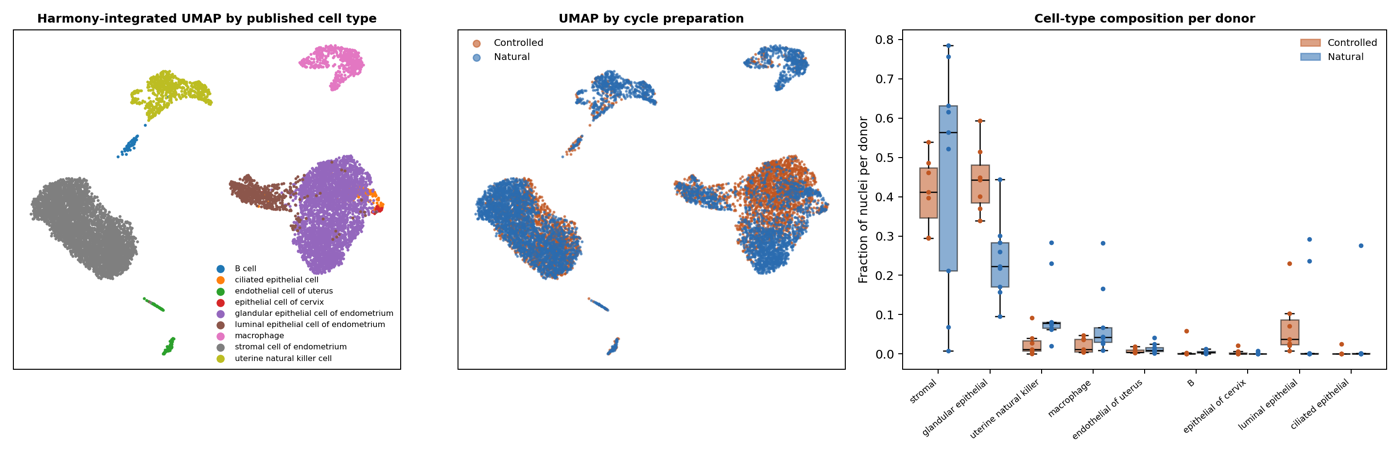
Endometrium snRNA-seq, donor-level pseudobulkPublic snRNA-seq data (16 donors, 93,064 nuclei), programmed vs natural cycle. Glandular epithelium makes up a larger share of nuclei in programmed cycles (44% vs 22%), and 79% of glandular DEGs hold when any single donor is left out.View code →
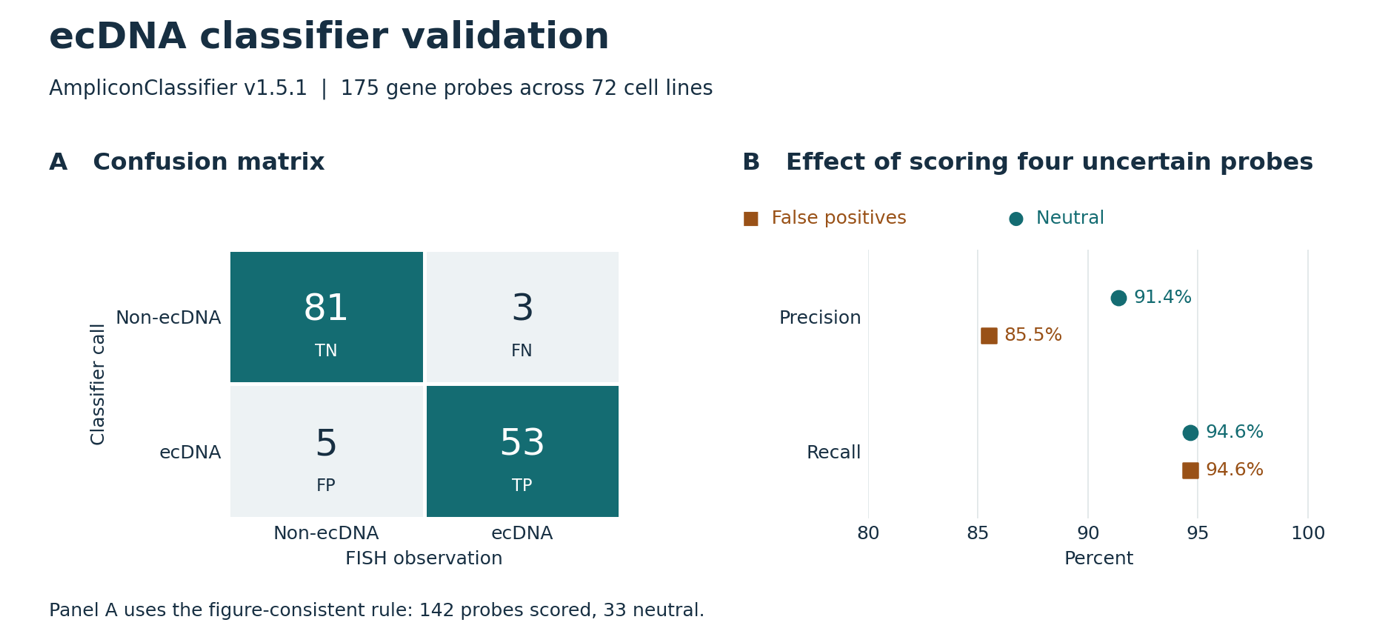
Reproducing an ecDNA classifier validationIndependent rebuild of the AmpliconClassifier FISH comparison (Nature Methods 2026) from deposited data: 175 gene probes in 72 cell lines, 91.4% precision and 94.6% recall.View code →
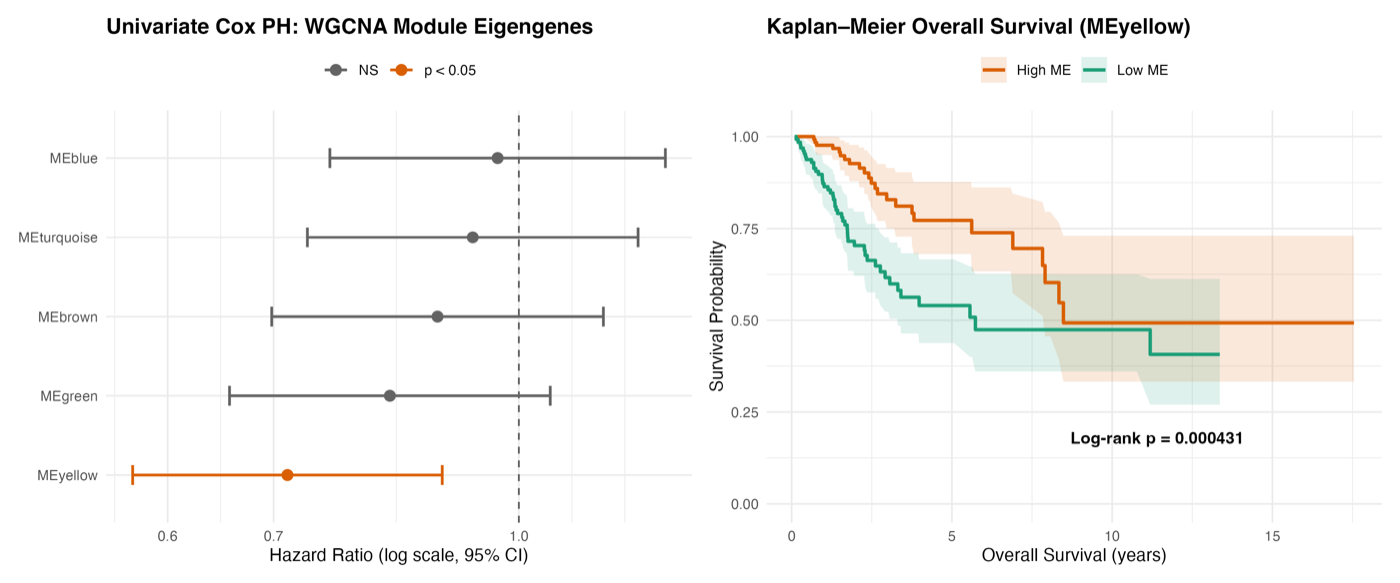
Co-expression modules and survivalTCGA cervical cancer cohort: of five WGCNA modules, only the yellow module is linked to overall survival (Cox HR 0.71, FDR 0.017; Kaplan–Meier log-rank p = 0.0004).View code →
Repositories
cgr-mfxdfa-gene-prioritization
Chaos-game + multifractal gene prioritisation
Turns gene sequences into frequency chaos-game matrices and ranks candidates by 2D multifractal cross-correlation with known cancer genes.
Independent reproduction of the AmpliconClassifier FISH validation (Luebeck et al., Nature Methods 2026): rebuilds Figure 1d–e from the deposited data across 175 gene probes in 72 cell lines, with a probe-level check of the scoring.
Snakemake workflow integrating ENCODE ATAC-seq, RNA-seq and CTCF ChIP-seq to link distal enhancers to genes, test CTCF occupancy with peak-level statistics and rank concordant candidates.
Scanpy/scverse workflow from GEO accession or 10x file to clusters and markers: MAD-based QC, doublet removal, UMAP, Leiden — deterministic, with fixed seeds.
Public 16-donor endometrium snRNA-seq (programmed vs natural cycle): donor-level pseudobulk PyDESeq2, CollecTRI/PROGENy activity with decoupler, and a leave-one-donor-out robustness check.
R/Bioconductor workflow on TCGA-CESC: limma differential expression, fgsea, signed WGCNA co-expression modules and Cox / Kaplan–Meier survival of module eigengenes and hub genes.
Leak-free cross-validated comparison of RNA, copy-number and combined models on TCGA-LUSC, with SHAP feature attribution and out-of-fold Cox survival scoring.
Minimal mechanistic model of tumour–immune interaction: bistability and equilibria, treatment what-if simulations, and parameter fitting to synthetic data. Illustrative parameters, not fitted to real data.
Marine Biological Laboratory, Woods Hole, USA·Oct 2022·Selected poster, session B
"Ascertainment of non-coding genes as key molecular players in cervical squamous cell carcinoma through the systems biology approach"
Mentoring
Supervised five MSc dissertation projects; train and support experimental colleagues in computational analysis2019 – 2024
Memberships
ISCB — International Society for Computational BiologyMember
RNA SocietyMember
FABA — Federation of Asian Biotech AssociationsMember
Get In Touch
Let's talk science, data, or opportunities.
I'm looking for computational biology / bioinformatics scientist roles in cancer genomics, gene regulation, and multi-omics — in academia or industry. Open to on-site, hybrid, or remote roles, and relocation within the EU or globally. Happy to talk about collaborations too.